Faculty of Engineering
“ Engineering in the 21st century is much different from what it used to be. Today, it requires adjusting to the fast-paced world and keeping up with development.” __Anastasia Moore.
Engineering has played an important role in our real-world innovation. At CamTech, we aim to provide our students with the best learning experience through the integration of scientific theories with project-based learning to solve real-world problems and create innovative entrepreneurial solutions that benefit humanity .
Learning objectives
- To promote an entrepreneurial spirit and to consider the option of setting up a company as an employment opportunity
- Development of entrepreneurial skills and use of tools that equip people to work in an entrepreneurial project
- Essential knowledge for those interested in managing their own business.
Mission
- Educate engineers: combining strong technical knowledge with a holistic, social conscience, incorporating the principles of system approach engineering with values such as community-centered knowledge to ensure engineering focus on sustainable development of society. Engage in research: learning through collaboration with industry, which is enhanced by external funding and collaboration and contribution of high-quality graduate students.
- Pursuit for entrepreneurship: providing the opportunities in our research, infrastructure, resource and learning to ensure maximum impact throughout the community and beyond.
- Pursuit for engineering knowledge that will serve our communities: through the practical application of engineering designs and products development by fought-year engineering students’ project based study.
Vision
The Faculty of Engineering will strive to be a dynamic center of engineering, innovation and creativity dedicated to teaching, lifelong learning, professionalism, research, entrepreneurship and partnership with local and global to grantee Cambodia’s future prosperity.
Framework
The program of the Faculty of Engineering (FENG) aims to continue from the foundation year to strengthen student general knowledge of various fields, such mathematics, science, arts, humanities, in addition to their specialization. To ensure the objective of FENG, a Connected Curriculum Framework will be adopted for program in faculty.
Faculty of Engineering
Interconnected Curriculum Framework
- Students connected with researchers and within the institute’s research: inviting students to connect with research at the start of the foundation year program to the end of their program in each major. Researchers are also encouraged to mentor students in the area of their research.
- A throughout of research activities is built into each programme: each programme of study is designed in such a way that students experience a connected sequence of learning activities and empower them, step by step using researching method of inquiry.
- Students make connections across subjects and out to the world: provide a platform for students to learn with other students and scholars including and from outside of their main subject field.
- Students connected academic learning with workplace learning: internship will be part of curriculum for every academic year. Students are encouraged to do their internship in university research groups, startups and outside related firms.
- Students learn to produce outputs-assessment directed at an audience: student’s work is not only being assessed by other students and faculty members, the international and local community will also participate in the process. Students are encouraged to engage in digital communication skills.
- Students connected with each other across phases and with alumni: program allows students to connect with each other across discipline and with alumni. Peer mentoring and students club body will be important for faculty academic programs and activities.
Program Structure of Bachelor of Engineering
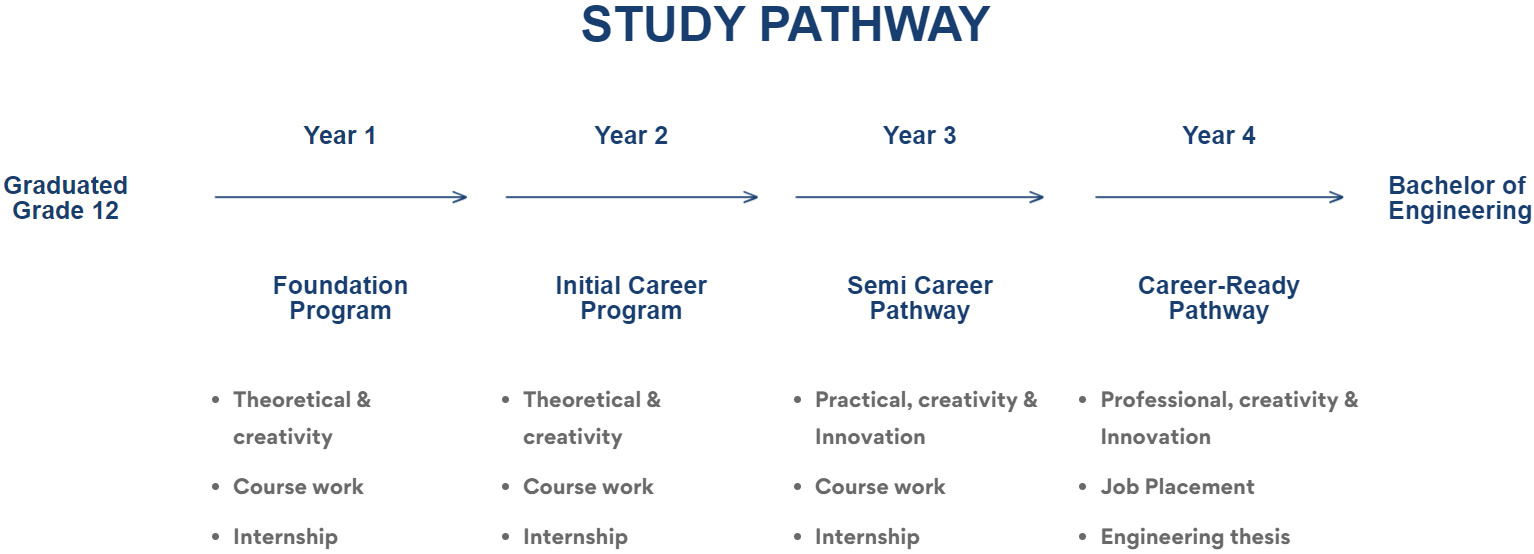
The 4-Year Bachelor’s Degree program contains 160 credit combing 134 credits of coursework and 26 credits of internship and thesis defense. The courses are divided into six categories, including Common Courses , Specialized Courses, Elective Courses, Internship Projects, Placement, and final thesis defence.
| No | Course | Number of Course | Number of Credit |
| 1 |
Common courses
|
18
|
36
|
| 2 |
Specialized courses
|
24
|
84 |
| 3 |
Elective courses
|
7 | 14 |
| 4 |
Internship including year 1-3
|
9 | 18 |
| 5 |
Industrial placement for whole 4th year and thesis defence
|
1 | 8 |
Structure of the professional diploma program
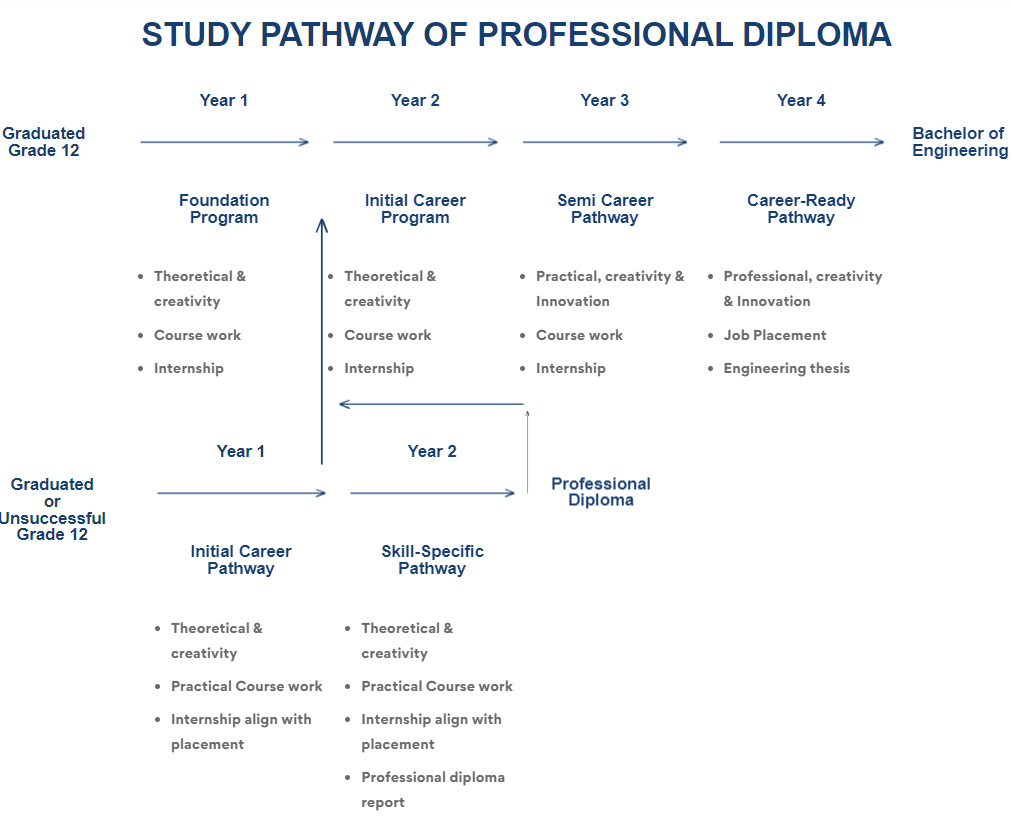
The Professional Diploma Program (PDP) at Cambodia University of Technology and Science (CamTech) is designed for a career-focused, accomplished associate degree or the equivalent. Student enrolled in the Professional Diploma will elevate their focus expertise to a professional level and learn critical skills in entrepreneurship, freelancing work, and other business-related skills.
PDP provides a passway to a full bachelor’s program after students complete the program and fulfill the requirements for their chosen major. Students enrolled in this program will identify a focus area that complements their major area studies and supports the development of their professional goals.
This program gives students the opportunity to deepen and expand their readiness to enter and be leaders within ever-changing specialties by broadening their skill sets and access to a variety of techniques ready for work.
Their coursework will prepare them to engage in repertoire planning that demands more diversity in programming, addressing current needs and gaps in the professional world.
The program includes a career-focused seminar, core coursework, and student-selected job placement learning, in addition to private lessons, large ensembles, and elective courses.
The 2-year Professional Diploma program contains 80 credits combining 70 credits of specialized coursework and 12 credits of internship and 4 credits for the final diploma project report.
| No | Course | Number of Course | Number of Credit |
| 1 |
Specialized courses
|
33 | 64 |
| 2 |
Internship in industrial including year 1-2 |
6 | 12 |
| 3 |
Diploma project report
|
1 | 4 |